Showing posts with label 15th century. Show all posts

Tuesday, February 10, 2026

Seventeenth-century Gamaleon sightings v2

The "Gamaleon" prophecy is an interesting case of remarkable fifteenth-century manuscript transmission (Frances Kneupper's Empire at the End of Time records 16 manuscripts in three versions) and considerable secondary literature, followed by near silence in print. There is a single printed edition of 1538 (VD16 O 508). Otherwise "Gamaleon" only appears in antiquarian collections, including Wolfgang Lazius' 1547 Fragmentum vaticinii and 1554 Catalogus aliquot antiquorum vaticinorumMatthias Flacius' 1556 Catalogus testium veritatis, and Johann Wolff's massive collection in 1600.

We can extend this slightly with a few mentions of Gamaleon in other sources. Editions of "Alofresant" printed in 1530-40 and expanded with additional texts, mostly borrowed from Lichtenberger's Prognosticatio, cite "Gamaleone" or "Damaleone" as one of their authorities (VD16 A 1936 and ZV 416, A 1934), but without including any of the "Gamaleon" prophecy. Caspar Füger's 1568 Weissagung von der künftigen Zerstörung deutsches Landes durch den Türken in verse includes a note referencing "Gamaleon" in the version attributed to the sermon of a Johann Wünschelberg of Amberg: Lichtenberger had prophesied an advance of the Turks to Cologne, and  "Desgleichen hat gesagt ein Prediger zu Ambergk/ Wintschelbürger genant. Was diese beyde sonst geweissaget haben/ soll alles also ergangen sein." For a century with an ongoing interest in prophecies, that's not much.

"Gamaleon" actually looks to be better attested in the seventeenth century. Short excerpts from the prophecy are found in the following editions:

Newe Zeitung auß Bayerlandt/ ... Die ander/ Von dem Gesicht oder Visio Hemalionis, welches zu Heydelberg in der Cantzeley ist gefunden worden, 16221 (VD17 1:070329C): "Es ist in einer Archa oder Kist/ so in hundert Jahren nit geöffnet/ darinnen allerhand Brieff und Documenta gewesen/ under andern auch diese Schrifft gefunden worden. Ein Brieff darinnen ein Kind gemahlt gewesen/ welches ein Cron auff dem Haupt gehabt/ unnd vier Schwerdter in seinen Handen die Oberschrifft ist genant worden Visio Hemalionis, etc..." 

This text appears to be reprinted in Klägliche und trawrige Newe Zeitungen... Die ander/ Von dem Gesicht oder Visio Hemalionis, welches zu Heydelberg in der Cantzeley ist gefunden worden, 1621 (VD17 23:246515X), but no full facsimile is available yet.

Warhaffte Propheceyung Dreyer im Bapstumb Hochberühmbter Fürtrefflicher Männer, 1632 (VD17 23:296469W): "Der Erste ist gewesen Johannes Wund. Schellenburgensis Theologus und Praedicator zu Hamburg/ welcher umbs Jar Christi 1400 und also länger als vor 200. Jahren gelebt hat/ dessen Wort in seiner Weissagung also lauten: Imperator veniet a meridiae, qui incipiet malum Ecclesiae...et possessionem auferent ab Ecclesia:" followed by a German translation of the excerpt.

Another edition of this work:  Warhaffte Prophezeyung Dreyer Im Bapstumb Hochberümbter Fürtrefflicher Männer, 1632 (VD17 23:250798L)

An excerpt from Johann Wolff's version of "Gamaleon" is then translated (likely back-translated) into German and included in Des Mitternächtiger Post-Reuters Passport, an extensive compilation that went through multiple editions in 1632:

Deß Mitternächtigen Post-Reutters Adeliches und untadeliches/ dreyfaches Paßport... (VD17 23:250899Y)

Des Mitternächtigen Post-Reuters Adeliches und Unadeliches dreyfaches Paßport... (VD17 23:657418F) 

Des Mitternächtigen Post-Reutters Adeliches unnd Untadeliches dreyfaches Paßport... (VD17 12:657636Q)

Des Mitternächtigen Post-Reuters Adeliches unnd Untadeliches dreyfaches Paßport... (VD17 14:005096H) 

Unterschiedliche Paßporten/ Deß auß Mitternacht Adelichen und untadelichen/ eylenden im Teutschland ankommenden Post-Reuters... (VD17 23:266493L)

In addition, an anonymous Latin Iudicium De Hodiernis Prognosticis Liberum published in 1623 (VD17 12:121696G) mentions "M. Johannes Vunschelburg, oppidi in Bavaria Ambergae praedicator: anno 1439" among its list of older prophecies. There is a German translation of the same work published in 1626 in: Germanus, Johannes. Der siebenden Apocalyptischen Posaunen/ von Offenbarung verborgener Geheimnussen Heroldt... (VD17 14:017658S).

In all, nine editions and two additional mentions: A respectable seventeenth-century showing for a late-fourteenth-century prophecy, with a chance of more to come.

Thursday, April 27, 2023

Digital text: Methodius, Revelationes [German], 1497

Who needs a digital text when digital facsimiles are available? I do. When I'm hunting citations or comparing versions, I need to be able to annotate, rearrange, and copy and paste. In addition, it's much faster to read an early modern text in a modern font, especially if I'm scanning a text I've read to find something I remember seeing previously. It's what makes the effort required to use OCR4all worth it.

Here's one result, for example: a complete digital text of Pseudo-Methodius' Revelationes in German, published in 1497 (ISTC im00526000, GW M23065; fascimile from the Bayerische Staatsbibliothek).

I've prepared the text for my own purposes, so:

  1. The numbers count images starting from the title page, not anything useful like leaves.
  2. I've made minimal effort to resolve abbreviations or normalize spelling.
  3. I'm using modern equivalents for s and z.
  4. I read through the text once to straighten out the formatting and catch errors, but there are undoubtedly still errors in the text.

The German text was more useful to me than the Latin text, and it uses fewer abbreviations. That does mean that this text doesn't include Wolfgang Aytinger's commentary on Methodius, so I might have to deal with it separately. I'm currently digitalizing a Latin work for the first time, and I don't know how well OCR4all will handle abbreviations yet.

I have several more texts like this that I'll post eventually, and I'm working on more as time permits. One goal is to end up with a workable electronic text of Lichtenberger's Prognosticatio.

Hopefully someone will find these working notes useful. If you need to cite something, cite to Albrecht Kunne's edition or a modern critical edition of Methodius.

Saturday, January 8, 2022

A Cedar of Lebanon sighting

 Wissenschaftliche Stadtbibliothek Mainz, Hs I 171 is a manuscript from the second half of the 15th century. The provenance is from the Carthusians of Mainz.

The text on ff. 21v-22r is identified as a "Vision de anno 1387." The title identifies it as a vision found in an old book: "Sequitur alia visio Reperta in uno antiquo libro."

The text is in fact the "Cedar of Lebanon" vision (see Robert Lerner's 1983 Powers of Prophecy for the definitive study).

The preceding text, the "Visio de anno 1454" on ff. 20r-21v, is the Revelatio I of Denis the Carthusian.

Thursday, April 19, 2018

The Extract of Various Prophecies

For the booklet of excerpts from Lichtenberger and Grünpeck and other sources known variously as the Auszug etlicher Prophezeiungen, Extract of Various Prophecies, and (inaccurately) as the "Anonymous Practica"/"Anonyme Praktik," whose most thorough previous description is pp. 145-53 in Heike Talkenberger's Sintflut (1990), I have a recently published article that clears up some of the mysteries:

Jonathan Green. “The Extract of Various Prophecies: Apocalypticism and Mass Media in the Early Reformation.” Renaissance and Reformation 40.4 (2017): 15–42.

  • The previously unknown source of the foreword is Simon Eyssenmann’s annual astrological prognostication for 1514 (VD16 E 4757).
  • The concluding 54 lines of verse are likewise not an original compilation, but appear to be taken from a 108-line poem printed together with an astrological prognostication or calendar for 1508; see Carl Gottfried Scharold, Dr. Martin Luthers Reformation in nächster Beziehung auf das damalige Bisthum Würzburg historisch dargestellt (Würzburg, 1824), 1:64n1, xx–xxiii (appendix item vi). Fragments of both previously unknown sources appear as pastedowns in the same volume (Augsburg, Staats- und Stadtbibliothek 4 Med 1284).
  • The extracts from Lichtenberger are most closely connected to an edition published in 1497 by Bartholomaeus Kistler in Augsburg (ISTC il00209000/GW M18245) and another set of extracts published in 1532 (VD16 ZV 11958).
  • The Dutch edition dated to 1509 (NB 26021) should be dated to around 1523.
  • The decisive actor behind publication of the Extract of Various Prophecies is Hans Stainberger, bookseller of Zwickau, although his personal involvement in composition is unlikely.
  • The 14 known editions of 1516-1525 make the Extract of Various Prophecies the most frequently printed prophetic work during that decade.
  • The circulation of the Extract of Various Prophecies is associated with several interesting Reformation-era controversies, and illustrates the spread of apocalyptic motifs and the formation of audiences for apocalypticism in Reformation-era Germany.
I sketch out the the relationship between texts and editions as follows (this image does not appear in the published article):

    Friday, June 23, 2017

    A very short review: Encyclopedia of Apocalypticism (1998)

    McGinn, Bernard, John Joseph Collins, and Stephen J. Stein, eds. The Encyclopedia of Apocalypticism. 3 vols. New York: Continuum, 1998. ISBN 978-0826412522.
    9780826412522
    9780826412522
    9780826412522
    9780826412522

    I usually save short reviews for academic work that is of the highest quality or makes a substantial impact on my own work. So this review is about 20 years late, but well deserved. I came across the three-volume Encyclopedia of Apocalypticism while browsing in the university library last fall and ended up reading it from cover to cover, from cover to cover, and from cover to cover - for all three volumes, from ancient Persia to the late twentieth century.

    The articles were on the whole well written, authoritative, and thoroughly documented. I thought there were only two real clunkers; the rest ranged from highly informative to truly excellent. Now matter how distant any article seemed at first, I found that almost every article was relevant to my research on early modern Germany and helped me see my work in a much broader context, while the best articles motivated me to rethink and redefine what I research and how I go about it. When I first started the research project that turned into Printing and Prophecy, I planned to look only at prophecy as a communicative act in late medieval and early modern Germany, but soon found I couldn't avoid dealing with astrology and the Reformation. Now I see that I can't avoid dealing with apocalypticism as well. The Encyclopedia of Apocalytpicism is going to be one of those reference works that stays near my desk for just about any research project.

    Friday, April 7, 2017

    A prognostication for Valentine's Day 1469 from the desk of Hartmann Schedel

    Bettina Wagner's work on letters, notes, and other miscellanea from Hartmann Schedel has uncovered quite a few interesting things, including this cataclysmic prognostication for 1469 copied onto a loose leaf. It's an interesting text that I haven't seen before. An attempt at a transcription and translation follow. Punctuation has been added and capitalization has been altered for sense and abbreviations have been resolved silently.
    Anno Mo cccco lxviiiio quartadecima die mensis Januraii incipietur delusio mundi, evacuatio cleri, derisio christianitatis, deposit[i]o potentiarum scilicet Imperatoris et regum. Insuper quartadecima die mensis februarii circa[?] meridiem eclipsabitur sol et quasi omnino emittet formam sue dispositionis. Et significat iiiior mala. Primum quod deus movebit celum et terram in suo empisperio quasi mundum subverteret. Secundum quod virtutes superiorum movebuntur scilicet ordo contra[?] ordinem. Tercium de magna et in audita sangwinis effusione qualis numquam fuit a mundi origine timendum est. Quartum fames magna ita quod maritus non curabit uxorem nec uxor maritum nec pater et mater prolem curabit, quia quasi unanimiter desperabunt. Post hec sequitur pestis in audita de uno in alterum precedens et pauci effugient. Sed qui superstites manebunt bene habebunt et in cunctis prosperabuntur.

    Dicitur quod hanc prenostica Scola Parisiensium fecit que missa dicitur magistro Johanne Gerstman.

    On the fourteenth day of January 1469 will begin the deception of the world, the purging of the clergy, the mockery of Christendom, and the cessation of power, namely of the emperor and of kings. And then on the fourteenth day of February around noon, the sun will be eclipsed and almost entirely expel the form of its disposition. [NB. Is the thought that the sun will lose its light and weaken, or shine out its entire force at once?] And this signifies four evils. First, that God will move heaven and earth in their orbits ["hemispheres"] as if to overturn the world. Second, that the powers of the superior [planets] will be moved, namely one order against the other. Third, one must fear a great and unprecedented outpouring of blood the likes of which have never been from the beginning of the world. Fourth, so great a famine that a husband will not provide for his wife, nor a wife for her husband, neither father and mother for them children, because almost all will be united in despair. After these things, an unheard of plague will follow, advancing from one side to the other, and few will escape it. But what survivors will remain will be well and prosper in all things.

    It is said that the school of Paris made this prognostication, which is said to have been sent to Master Johannes Gerstman.

    The text, an amalgamation of astrology and catastrophic prophecies, bears some resemblance to the "Toledo Letter" and to the prognostication of "Meister Theobertus von England" printed around 1470 both in their construction and in their attributions to foreign astrologers. According to the NASA catalog of solar eclipses, there was a solar eclipse on 13 January 1469, which approximately matches one of the dates in the prognostication, but that eclipse was not visible in Europe. The eclipse of 9 July 1469 would have been much more dramatic. The closing note that anyone who survives will experience marvelous things is a motif that appears many times, particularly in the lead up to 1588.

    Saturday, August 22, 2015

    BAV Pal. lat. 461: "Prophetia Sibille conscripta per Ioachim prophetam" = Gallorum levitas

    For the last few months at least, volumes formerly held in Heidelberg and now in the Vatican library have been appearing in the digitalization project of the Heidelberg Universitätsbibliothek. I try to take at least a quick look at each miscellany as it appears, and one of them, Pal. lat. 461, included a "Prophetia Sibille conscripta per Ioachim prophetam," which sounded promising. The first few words quickly revealed this to be a garbled fifteenth-century copy of the "Gallorum levitas" prophecy:
    Gallorum levitas / germanis iustificabit /
    Ytalie gravitas / gallus confuse negabit /
    Annis millenis tricentis novagenis /
    Ter denis adiunctis / consurgit aquila grandis
    Constantina cadet et equi de marmore facti
    Et lapis erectus et erunt victricia signa
    Gallus succumbit / vix erit urbs presule digna
    Papa cito moritur / Cesar ubique regnabit
    Sub quo cuncta vana / cessabit gloria cleri

    This looked interesting, so I checked the secondary literature. Here's Robert Lerner (Powers of Prophecy 191 n. 11): "Unpublished MS copies of this text, which underwent numerous alterations, are so numerous as to be virtually beyond surveying."

    Oh, well. But here's another one!

    * * *

    I've moved again. The new semester has already started, so posting will resume, but may be sporadic for a while.

    Friday, April 24, 2015

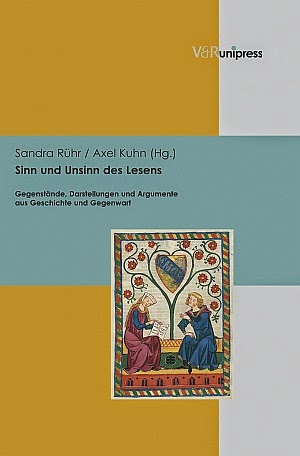
    A very short review: Sandra Rühr and Axel Kuhn, eds. Sinn und Unsinn des Lesens (2013)

    Sandra Rühr and Axel Kuhn, eds. Sinn und Unsinn des Lesens: Gegenstände, Darstellungen und Argumente aus Geschichte und Gegenwart. Göttingen: V & R Unipress, 2013. 246 pp. 978-3847-101284.
    http://www.v-r.de/de/sinn_und_unsinn_des_lesens/t-0/1011005/

    Ceci n'est pas une Festschrift

    This book is not a Festschrift. It is instead a volume of well-executed, thematically coherent essays with real scholarly merit published in honor of Ursula Rautenberg's sixtieth birthday. As the editors and authors have taken pains to avoid the defects often found in Feschschriften, the collected volume is a fitting tribute to the honoree.

    The essays are arranged in order of their chronological focus, which spans the range from medieval manuscript practice to contemporary book marketing and the future of reading. These include the following:
    • Siegfried Grosse, "Versmaß, Reim  und Syntax: Überlegungen zur oralen Poesie" examines the significance of early twentieth-century recordings of story-telling during women's down-plucking circles for our understanding of medieval literature as oral performance.
    • Anro Mentzel-Reuters, "'Wer hat mich guoter uf getan?' Studien zur volkssprachlichen höfischen Lesekultur des Hochmittelalters" presents empirical evidence (based on page size, book weight, letter height, and internal lighting conditions) for the practical use of medieval manuscripts for individual or group reading. I'm already beginning to cite this chapter.
    • Nikolaus Weichselbaumer, "'Sie solllen lesen bei Tag und bei Nacht': Akzeptanz und Funktion scholastische Leseformen" treats the transition from monastic to scholastic modes of reading with exceptional concreteness and clarity.
    • Edoardo Barbierei, "A Peculiarity of the 'Glossae' by Salomon III. of Constance" suggests that a 1474 edition of the Glossae went to press before the actual extent of another included text was known.
    • Oliver Duntze, "'The sound of silence': Eine unbekannte 'Ars punctandi' als Quelle zur Geschichte des Lesens in der Frühen Neuzeit" provides a wide-ranging overview of punctuation manuals as sources for the history of reading practices.
    • Mechhild Habermann, "Lesenlernen in der Frühen Neuzeit: Zum Erkenntniswert der ersten volkssprachlichen Lehrbücher" finds in sixteenth-century didactic works on reading evidence for a new approach to reading based on meaning rather than letters, and for an increased regard for the value of reading.
    • Hans-Jörg Künast, "Lesen macht krank und kann tödlich sein: Lesesuch und Selbstmord um 1800" investigates medical treatises as a new source for the reading revolution of the late eighteenth century and official concerns about it.
    • Ute Schneider, "Anomie der Moderne: Soziale Norm und Kulturelle Praxis des Lesens" considers the formation of a literary canon and the codification of reading practices in the context of the formation of a German national identity during the nineteenth century. 
    • Heinz Bonfadelli, "Zur Konstruktion des (Buch-)Lesers: Universitäre Kommunikationswissenschaft und angewandte Medienforschung" treats a seemingly simple yet consequential question: how does academic study of media and communication differ from the study of media markets and usage within the industry, and how does the treatment of books and reading compare to approaches to other media in each sphere? A serious course about the German media should include this chapter on its reading list.
    • Lilian Streblow and Anke Schöning, "Lesemotivation: Dimensionen, Befunde, Förderung" reviews studies of reading education in Germany in the aftermath of the PISA-test debates.
    • Sven Grampp, "Kindle's Abstinence Porn: Über Sinn und Sinnlichkeit digitaler Lesegeräte in der Werbung" performs a close reading of a televised Kindle advertisement and dissects its use of gender roles.
    • Axel Kuhn, "Das Ende des Lesens? Zur Einordnung medialer Diskurse über die schwindende Bedeutung des Lesens in einer sich ausdifferenzierenden Medienlandschaft" surveys twentieth- and twenty-first century discourses in which predictions of doom for literacy, books, printed books as opposed to e-books, and reading as a primary cultural technique have been made; at the end, Kuhn remains optimistic for the future of reading and skeptical of the prophets of doom.
    These are well-written, thought-provoking essays which together add up to more than the sum of their parts. Es lebe die nicht-Feschschrift!

    Friday, March 27, 2015

    Incunable leaf sizes

    Confirmed: The earliest printed books look very much like books. Specifically, the ratio of leaf height to leaf width and the height-width ratio of the type space are precisely what you would expect.

    That sounds complete uninteresting, but before making that statement in an article I'm working on, I wanted some actual data. That's the tricky part, however, as most incunable catalogs, and all of the incunable databases that I'm aware of, only record the format - as opposed to manuscript catalogs, which usually record the page dimensions, but not the format. Thanks to a tip from Oliver Duntze, I checked the British Museum incunable catalog. For 23 Mainz codex editions to 1470 recorded in BMC, the average leaf size ratio is 1: 1.44, while the type space ratio (from 25 editions) is a bit narrower, 1: 1.51. There is some variation, but most of these early printed books fall quite close to the mean, as the plot below shows. Leaf size is in red, while type space dimensions are in blue, with linear trend lines added to each.
     Fig. 1: Leaf height and width (red) and writing space height and width (blue) in Mainz codex editions to 1470.

    To compare incunable leaf sizes rather than ratios, the BMC records for Mainz printing to 1470 might not be the best source, as many of those volumes are deluxe folio editions on vellum. Instead I referred to the Bodleian Library incunable catalog, which also provides leaf sizes. The graph below shows the leaf height for 15 folio editions, 26 quarto editions, and 2 octavo editions. More editions would of course be preferable, but since I don't have electronic records to work with, the data have to be entered manually. You can in any case already see the distinct formats: octavo leaf heights appear in red, quartos in gray, and folios in blue.
     Fig. 2: Leaf heights (mm) of a selection of folio (blue), quarto (gray), and octavo (red) incunables from the Bodleian Library.

    Two things stand out: First, the folios clearly comprise different paper sizes, one with an average height around 290 mm, and another with an average height around 410 mm. Second, small quartos overlap with octavos. It would be interesting to look at more leaf sizes of these smaller formats.

    Friday, March 13, 2015

    The history of the late medieval book in one boxplot

    One of the basic ways to describe the types used for fifteenth-century printed books is the method refined by Konrad Haebler that involves, among other things, measuring the height of twenty lines of type. The height of a typeface affected its legibility, or how far a reader could be from a text and still be able to read it. The height of the type was also significant in relation to the other types used in a book, as a type taller than the one used for the main text often identified titles and other structural paratexts, while a shorter type was typically used for marginal commentary. So what at first glance might sound like a number only interesting to antiquarians turns out to have some interesting implications for the history of reading as a cultural practice.

    With the availability of the Typenrepertorium der Wiegendrucke as an electronic resource linked to the Gesamtkatalog der Wiegendrucke, it's now possible to survey type heights systematically, so it should be possible to look at how type heights develop during the fifty years following the invention of printing. What may not be obvious is that we can do something similar for German manuscripts as well, as the Handschriftencensus records the height of the writing space and the number of lines for manuscripts where this can be determined - so we can divide the writing space height by the number of lines, multiply by twenty, and arrive at the "Haebler height" for each manuscript.

    The boxplot below summarizes the means and 25th/75th-percentile limits for German vernacular mansucripts between 1351 and 1450 (with approximate dates coerced to a single year), and printed books separated by decade (with the 1450s and 1460s combined due to the small number of editions from the 1450s). While we're measuring what I think are comparable things, they're not precisely the same: the left column is looking at the line height per manuscript, while the other four columns look at the line height per occurrence of a give type - so a type used in five editions over fifteen years will be counted five times over two different decades. This is, I think, the best way to determine what a typical book might look like, with a frequently-used type counted more times than a type that was only used once. (To be completely consistent, we would also need to look only at books printed in Germany rather than all incunables.)
    The next boxplot limits the y axis to make the picture clearer.
    What we see here is that the earliest printed books used types that were very similar in height, on average, to the line heights found in manuscripts over the preceding century, while the 1470s form a period of transition between the earliest printed books and the 1480s and 1490s, when noticeably smaller types were preferred. The use of smaller types allowed for the production of less expensive books, with more printed text per unit of paper, but it took a few decades before the technical possibilities of the printing press could reshape reader's expectations for what their books should look like.

    Friday, February 20, 2015

    How atypical are the editions in Eric White's census of print runs?

    In the introduction to his census of known fifteenth-century print runs, Eric White cautions against taking his results as representative for all incunables:
    As the census will make immediately apparent, a large percentage of editions for which we know the print runs were produced to fulfill institutional functions.... Remunerative and relatively risk-free for printers, the original commissions for projects such as these tended to end up in surviving archives, and they tended to afford very large editions. It should be noted, therefore, that the print runs known from such institutional commissions do not represent a normative cross-section of fifteenth-century press production, but rather a selection of large scale projects carried out with institutional funding and pressure to produce. As a group they almost certainly reflect higher-than-average print runs.... Moreover, the majority of the recorded print runs reflect the output not of the ‘average’ printing shop, but rather that of a few exceptionally successful publishers who received commissions from well-funded institutions. It is worth remembering that a documented print run may not be a representative print run.
    White's characterization of his sample is correct. Compared to all recorded incunables in the ISTC, folios are much more prevalent in the print run census, while quartos are underrepresented, and broadsides do not appear at all.
    Comparison of format distribution 

    For each format, the books are also substantially longer, with the average number of leaves 60-100% higher than for the ISTC as a whole. (NB: Averages can be a misleading way to describe the distribution of leaf counts, but they give a correct impression in this case.)

    Comparison of average leaf count by format

    White's suggestion that the sample of known print runs enjoyed a better survival rate than other incunables is also correct, with an average number of surviving copies 20-65% higher than what one finds for the ISTC as a whole. (NB: Averages can be even more misleading for describing survival rates.)
    Comparison of average surviving copies by format

    This doesn't mean that we should ignore White's census of print runs as an atypical sample, however. Rather, we can say that its sample differs from the body of known incunables in various ways, some of which have well-understood effects. For example, the size and format of editions in White's sample are larger on average than for the ISTC as a whole, and the included editions likely benefited from association with an institutional sponsor, all of which are associated with higher survival rates than other fifteenth-century printed books, so that we would expect the survival rate for White's sample to be higher than for the ISTC as a whole.

    Friday, December 12, 2014

    CFP: Medieval Media (Special Issue of Seminar: A Journal of Germanic Studies)

    There's still more than two weeks left to submit an abstract for a proposed special issue of Seminar that Markus Stock and Ann Marie Rasmussen are putting together. The CFP sounds intriguing, and I think I have something that might fit their project. Now that we've reached the end of the semester, I should have time to work up an abstract.
    Medieval Media. Special Issue of Seminar: A Journal of Germanic Studies
    In recent years, the mediality of premodern and early modern literary and cultural communication has become a focal point in Medieval and Early Modern Studies. Media of transmission, communication, and dissemination have received heightened scrutiny. Scholarship is expanding our understanding of ways in which different kinds of material objects serve as media, and there is renewed interest in the role played by materiality and mediality in the re-circulation, appropriation and adaptation of shared stories, images, and ideas. For a special theme issue of Seminar: A Journal of Germanic Studies, we welcome contributions that take stock of this recent shift in scholarly attention and that probe questions of medieval and early modern mediality from broadly conceived disciplinary and interdisciplinary perspectives. We seek to include contributions from a range of different fields in medieval and early modern studies, drawing on various frameworks and approaches, including: history; art history; literary studies; textual criticism; material studies; architectural history; editorial theory and practice; digital humanities. We are seeking contributions focusing on case studies as well as contributions discussing broader methodological questions.

    Lines of inquiry may include:
    • Orality, writing, print: the simultaneity of medieval and early modern media.
    • Text and image reconceptualized as forms of intermediality.
    • Types of media material: stone, wood, parchment, wax, metal, voice.
    • Relationship between the media’s materiality and the semantics of texts or content more broadly construed.
    • Manuscripts as artefacts.
    • Rules, types, and situations of media use.
    • Histories and concepts of media.
    • Mediality in medieval and early modern Catholic religious thought (annunciation, incarnation, sacraments, liturgy).
    • Mediality in medieval and early modern Judaism and Protestantism (preaching; reading; use of images).
    • The body as medium.
    • The charisma of objects.
    • Remote communication (messengers, letters etc.).
    • Media within media: imitation, representation, and appropriation of different types of media in other media.
    • Premodern and early modern multi-media: song, dance, play, images, word, text.
    • Spaces and places of media use: court, castle, monastery, church, city houses, city streets, villages, etc.
    • The Where of the message: walls, books, bodies, badges, etc.
    • Social distribution of media use: media of peasants; burghers; nobles, of members of religious orders, etc.
    • Medieval texts and images in contemporary media (comic books; television; computer games; film).
    • Modern digital tools offering new research approaches to the medieval past.
    Please send abstracts of ca. 250 words to both Ann Marie Rasmussen (annmarie.rasmussen@duke.edu) and Markus Stock (markus.stock@utoronto.ca) by January 1, 2015. Decisions on inclusion will be made by February 1, 2015. The due date for the submission of articles will be July 1, 2015. All submissions will be subject to peer-review.

    Friday, November 21, 2014

    Really early, very small, printed German literature (in the narrow sense)

    If you want to look at the literary works that would have been accessible to the broadest range of people in the fifteenth century, then one place to start is with works printed in the vernacular and in smaller formats. In the vernacular, education is less of a barrier, and in the smaller formats (initially defined as broadsides, octavos, and quartos of less than 48 leaves), the economic challenge of acquiring literature is as low as it gets at the time. To look at the market for these works before printing reorganized the market for texts and the medium of the book, it makes sense to look only as late of 1480.

    While I'm actually in favor of an expansive definition of literature and an inclusive approach to the objects of literary study, a narrow definition of literature is sometimes pragmatically necessary. We'll eliminate for now saints' lives and other devotional works, and pragmatic and educational texts (including history, current events, and the natural world).

    Given those criteria, the resulting bibliography is quite short. It can be succinctly categorized like this:

    Narrative works and literary classics
    The first two clearly belong together. The Ackermann is an established part of the literary canon, but it's more similar in some ways to the humanist works below. On the other hand, the Ackermann and Pfaffe Amis have a considerable manuscript tradition, while the Pfarrer von Kahlenberg is only known in print.
    • Der Stricker, Pfaffe Amis (ca. 1478, GW M4411)
    • Philipp Frankfurter, Der Pfarrer von Kahlenberg (ca. 1480, GW 10287)
    • Johannes von Tepl, Der Ackermann von Böhmen (1463-1477, GW 193-198)
    Humanist translations
    These end up being the works of just two translators: Heinrich Steinhöwel and Nikolaus von Wyle.
    • Heinrch Steinhöwel/Fracesco Petrarca, Griseldis (1470-1480, GW M31576-78, M31580-81, M31583, M3158410, M31597)
    • Heinrch Steinhöwel, Apollonius of Tyre (1471, GW 2273)
    • Leonardus Aretinus/Nikolaus von Wyle, Guiscardus et Sigismunda (1476, GW 5643, 564210N)
    • Aeneas Sylvius Piccolomini/Nikolaus von Wyle, Euryalus et Lucretia (1478, GW M33548)
    • Lucian/Nikolaus von Wyle, Der goldene Esel (1477-1480, GW M18985, M18988)
    Hans Folz
    For shorter literary works to 1480, Folz only makes it in by two years, but even in that short time he has too many titles to list.
    • Sixteen titles (in seventeen editions) from 1479-80
    Border cases
    These are works that might be excluded as devotional or educational works under a narrow definition of literature. As I prefer a broad definition, I'll include them here.
    • Die wunderbare Meerfahrt des hl. Brandan (1476, GW 5004)
    • Sibyllen Weissagung (1452, 1475; GW M41981, M41983)
    • Visio Fulberti (1473, GW 10422)
    • Wie Arent Bosman ein Geist erschien (1479, GW 4944)

    Friday, September 12, 2014

    Let's learn R: histograms for the humanities

    To avoid all misunderstanding, let me make two things completely clear at the beginning: I don't know statistics and I don't know R. I did a math minor as an undergraduate, and I like to experiment with software that looks like it might be useful. That's all. Comments and corrections are welcome.

    But it's been clear to me for some time that several research problems in the humanities have statistical implications, or could be productively addressed through statistical methods, and the gradually rising profile of the digital humanities will likely make statistical methods increasingly useful.

    Estimating the number of lost incunable editions is one example of a research problem that required statistical expertise. For that, Paul Needham and I partnered with Frank McIntyre, an econometrician now at Rutgers. But I can't bug Frank every time I have a statistics question. He actually has to work in his own field now and again. Even when we're working on a project together, I need to understand his part enough to ask intelligent questions about it, but I haven't been able to retrace his steps, or the steps of any other statistician.

    This is where R comes in. R is a free and open source statistical software package with a thriving developer community. I've barely scratched the surface of it, but I can already see that R makes some things very easy that are difficult without it.

    Like histograms. Histograms are simply graphs of how many items fit into some numerical category. If you have a long list of books and the years they were printed, how many were printed in the 1460s, 1470s, or 1480s? Histograms represent data in a way that is easy to grasp. If you've ever tried it, however, you know that histograms are a huge pain to make in Excel (and real statisticians complain about the result in any case).

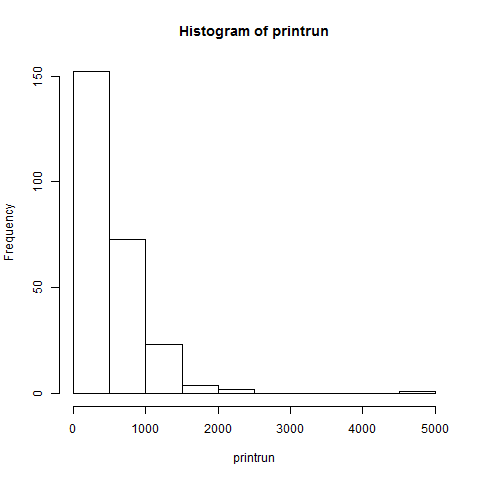
    To illustrate how easy it is in R, let's turn again to Eric White's compilation of known print runs of fifteenth-century books. Here's how to make the following histogram in R:

    > hist (printrun)


    It really is that fast and simple.

    Of course, there are a few additional steps that go into it. First, we need some data. We could put our data in a simple text file (named data.txt for this example) and open the text file. On Windows, R looks for files by default in the Documents library directory. If we only include the print runs in the text file, then R will number each row and assign a column header automatically.

    To read the file into R, we need to assign it to a vector, which we'll call x:

    > x <- read.table ("data.txt")

    If we want to use our own column header, then we need to specify it:

    > x <- read.table ("data.txt", col.names="printrun")

    But my data is already a column in an Excel spreadsheet with the column header printrun, so I can just copy the column and paste it into R with the following command (on Windows) that tells R to read from the clipboard and make the first thing it finds a column header rather than data:

    > x <- read.table ("clipboard", header=TRUE)

    To see what's now in x, you just need to type

    > x

    and the whole thing will be printed out on screen. We can now access the print runs by referring to that column as x$printrun, but it might simplify the process by telling R to keep the table and its variables - its column headers, in other words - in mind:

    > attach (x)

    At this point, we can start playing with histograms by issuing the command hist (printrun) as above. To see all our options, we can get the help page by typing

    > ?hist

    The first histogram is nice, but I would really like to have solid blue bars outlined in black:

    > hist (printrun, col="blue", border="black")

    The hist() command uses an algorithm to determine sensible bin widths, or how wide each column is. But 500 seems too wide to me, so let's specify something else.  If I want bin widths of 250, I could specify the number of breaks as twenty:

    > hist (printrun, col="blue",border="black", breaks=20)


    Last time, I used bin widths of 135 and found a bimodal distribution. To do that again, I'll need to specify a range of 0 to 5130 (which is 38 * 135):

    > hist (printrun, col="blue",border="black", breaks=seq (0, 5130, by=135))

    To generate all the images for this post, I told R to output PNG files (it also can do TIFFs, JPGs, BMPs, PDFs, and other file types, including print-quality high resolution images, and there are also label and formatting options that I haven't mentioned here).

    > png ()
    > hist (printrun)
    > hist (printrun, col="blue", border="black")
    > hist (printrun, col="blue",border="black", breaks=20)
    > hist (printrun, col="blue",border="black", breaks=seq (0, 5130, by=135))
    > dev.off ()

    It's as simple as that. Putting high-powered tools for statistical analysis into the hands of humanities faculty. What could possibly go wrong?

    * * *

    I have a few more posts about using R, but it may be a few weeks before the next one, as I'll be traveling for two conferences in the next several weeks. Next time, I'll start using R to retrace the steps of Quentin L. Burrell's article, "Some Comments on 'The Estimation of Lost Multi-Copy Documents: A New Type of Informetrics Theory' by Egghe and Proot," Journal of Informetrics 2 (January 2008): 101–5. It's an important article, and R can help us translate it from the language of statistics into the language of the humanities.

    Friday, September 5, 2014

    Abstract: "Bibliographic databases and early printing: Questions we can’t answer and questions we can’t ask"

    For the upcoming meeting of the Wolfenbütteler Arbeitskreises für Bibliotheks-, Buch- und Mediengeschichte on the topic of book history and digital humanities, the paper I'm giving will briefly summarize the paper I gave at the "Lost Books" conference in June, then look specifically at the bibliographical databases of early printing that we have today. These databases are invaluable, but their current design makes some kinds of research easy and other kinds quite difficult. Along with charts and graphs, my presentation will look at some specific examples of what can and can't be done at the moment, and offer some suggestions of what might be done in the future.

    Abstract: Bibliographic databases and early printing: Questions we can’t answer and questions we can’t ask.
    In 1932, Ernst Consentius first proposed addressing the question of how many incunable editions have been lost by graphing the number of editions preserved in a few copies or just one and projecting an estimate based on that graph. The problem Consentius posed is in fact only a variation of a problem that can be found in many academic fields, known in English since 1943 as the “unseen species problem,” although it has not been recognized as such until very recently. Using the well-established statistical methods and tools for approaching the unseen species problem, I and Frank McIntyre have recently updated the estimate that we first published in 2010. Depending on the assumptions used, our new estimate is that between 33% (of all editions) and 49% (of codex editions, plus an indeterminate but large number of broadsides) have been lost.

    The problem of estimating lost editions exemplifies how data-drive approaches can support book history, but it also illustrates how databases of early printing impose limits on research in the way they structure their records and in the user interfaces by which they make data available. Of the current database projects relevant for early printing in Germany (GW, ISTC, VD16, VD17, and USTC), each has particular advantages in the kinds of data it offers, but also particular disadvantages in how it permits that data to be searched and accessed. Clarity and consistency of formatting would help in some cases. All of the databases could profit by adding information that only one or none of the databases currently provide, such as leaf counts. User interfaces should reveal more of each database’s fields, rather than making them only implicitly visible through search results. Monolithic imprint lines, particularly those that make use of arcane or archaic terminology, must be replaced by explicit differentiation of printers and publishers.

    Of the current databases, the technological advantages of VD16 are often overlooked.  Its links from editions to a separate listing of shelf marks makes it possible to count copies more simply and accurately than any other database, and its links from authors’ names to an external authority file of biographical data provide the basis for characterizing the development of printing in the sixteenth century.  Most importantly, VD16 provides open access to its MARC-formatted records, allowing an unequaled ease and accuracy when analyzing records of sixteenth-century printing. Many VD16 records lack information about such basic information as their language, however.

    The missing language fields in VD16 provide an example of the challenges faced in attempting to compare bibliographic data across borders or centuries. One approach to this problem, taken by the USTC as a database of databases, is to offer relatively sparse data to users. I suggest as an alternative to this a different approach: Databases should open their data to contributions from and analysis by scholars all over the world by making their records freely available. Doing so will allow scholars of book history to pursue data-driven approaches to questions in our field.

    Friday, August 15, 2014

    Adding an author to a fragmentary incunable prognostication

    Identifying the author of a fragmentary annual prognostication is sometimes difficult, requiring a significant amount of research. Other times, it only takes a few minutes.

    This week, the Heidelberg university library released a facsimile of ISTC ip01005937/GW M35611, a fairly extensive fragment that is lacking an incipit, so no author had been identified. Leaf 1v did provide a complete list of chapters, however, and the structure looked familiar. After checking my records, I found that the text of the fragment was identical to that of another incucanble edition: Bernardinus de Luntis, Judicium for 1492 (Rome: Stephan Plannck, [around 1492]; ISTC il00392200, GW M19510). The identity of the two texts can be verified by comparing the facsimile provided by the BSB, so Bernardinus de Luntis should be added as the author to ISTC ip01005937/GW M35611. I sent a note on to Berlin to that effect.

    Bernardinus de Luntis is otherwise known to ISTC/GW only through one additional practica, for 1493: ISTC il00392300/GW M19511, again printed by Stephan Plannck. It's not unusual for astrologers to have a career in print that only lasted a few years, but the distribution of surviving copies is a bit odd in this case: apart from one copy in the Vatican, the other three are all in German-speaking Europe, in Basel, Heidelberg, and Munich. Apart from a brief mention by Simon de Phares in his Recueil des plus célèbres astrologues, not much appears to be known about Bernardinus de Luntis.

    Update: Klaus Graf adds a few more references to Bernardinus de Luntis here.

    Wednesday, July 23, 2014

    All sheets are not created equal

    At the recent Lost Books conference in St Andrews, a topic that came up during discussion was "survival of the fattest": Books with more leaves tend to survive in greater numbers of copies that thinner books. The USTC apparently has plans to include the number of sheets used in the production of each edition.

    The number of sheets is useful, but not quite the key information that one would hope it would be. As Frank McIntyre and I were preparing our paper, we originally considered sheet counts as a way to to enable comparison between formats. If you fold a sheet in half for a folio, or in four for a quarto, or in eight for an octavo, should be of no concern: a sheet is a sheet is a sheet.

    Alas, it is not so. When it comes to book survival, how that sheet gets folded matters, as format is still the single most important variable in book survival.

    For example, consider books of 8-16 sheets, including folios of 17-32 leaves, quartos of 33-64 leaves, and octavos of 65-128 leaves. Those are thin folios, handy quartos, and thick little octavos, but all composed of the same number of sheets. (Ideally, we would also factor in paper sizes, but that will have to wait for another generation of bibliographic databases.)

    If we graph the percentage of incunable editions that survive in a given number of copies, this is what we find:


    Despite all having 8-16 sheets, 12% of these folios survive in a single copy, while 20% of the quartos and nearly 30% of the octavos are known by just one copy. Book format informed choices about production, use, and survival more than leaf count did, and in a way that can't be reduced to a simple matter of bulk.

    Friday, May 9, 2014

    German vs. Latin printing, 1450-1700

    As I was looking at an older volume of the De Boor/Newald Geschichte der deutschen Literatur, I came across a claim for the percentage of German-language printing that struck me as a bit off. Now that we have some better data from GW/ISTC, VD16, and VD17 to work with, it should be possible to compare German and Latin printing across two and a half centuries, from 1450 to 1700 - at least with a few caveats. For incunables, I'm including only what the ISTC assigns to the region of Germany. VD16 doesn't include broadsides, so for the sake of consistency we should exclude broadsides from the incunables and seventeenth-century books as well, as the percentage of vernacular broadsides can be surprisingly high at times. Also, VD16 only includes language data for not quite half of its titles, so we'll have to compare percentages rather than title counts, and hope that VD16 has provided language data for a reasonably random sample. We also have to keep in mind that VD16 indexes every title in a volume separately, so one volume including multiple titles will be counted multiple times - which is less of a concern, as we're interested in the overall percentage. Finally, we're ignoring bilingual works.

    Here's the graph:


    What we find for 1480-1600 is not substantially different than what you can find in Uwe Neddermeyer's Von der Handschrift zum gedruckten Buch (2:698, diagram 12a, Reich/nationalsprachlich), although I find the longer time frame of my graph helpful. Vernacular printing declines after the 1480s, experiences a sharp rise at the time of the reformation, then settles into a slow decline that lasts until the outbreak of the Thirty Years' War. The amount of change between 1530 and 1700 is really quite modest, however.

    Friday, April 25, 2014

    Eric White, "A Census of Print Runs for Fifteenth-Century Books" (2012): the missing graphs

    Recently I came across Eric White's census of all known incuncable print runs, similar to that of Uwe Neddermeyer but more cautious in the kinds of sources he accepts. In short, White includes only historically documented sources and excludes broadsides, and his introduction explains why even documented print runs must be interpreted carefully.

    Instead of treating them carefully, I've plugged his numbers into a spreadsheet to generate some quick graphs in order to get a look at the distribution of print runs documented by White.

    In his introduction, White is concerned about the distorting effect of one outsize print run on the average, but the easiest way to deal with that is to provide a median instead: Where the arithmetic mean is 593, the median is 500.

    But the median may also not be the right figure. Here's the overall distribution, and it seems that we're still dealing with a bimodal distribution. (In all of the graphs - but not the calculations - I've exclude the one edition, ib01102000, with a print run of 5000, in order to keep the column widths sensible, and I've used a bin size of 135 in order to keep all those Sweynheym and Pannartz 275-copy editions together).

    Fig. 1: Distribution of fifteenth-century print runs

    Just as we saw when looking at Neddermeyer's list, most print runs fall into the range of 271-405 and several more between 406-540, while there's a secondary peak around 946-1080 (nearly all the recorded print runs in this group are right at 1000).

    But how much of this is due only to Sweynheym and Pannartz? If we exclude their records, we still find a bimodal distribution, although the two peaks are more equal in size.
     
    Fig. 2:  Distribution of fifteenth-century print runs, excluding Sweynheym and Pannartz

    One interesting observation is that the bimodal nature of the distribution disappears nearly entirely if we look only at the folios. This doesn't mean there were no folio editions with large print runs, but that they were rather uncommon in comparison to the number of editions with print runs in the range of 271-540. For folios, the average print run is 535, while the median is 400.

     Fig. 3:  Distribution of fifteenth-century print runs, folios only

    The majority of the bimodal character of the distribution instead comes from the smaller formats, the quartos and octavos. The mean for quartos and octavos is 715, while the median is 568. It would be more accurate, however, to say that the major mode is around 300, and the minor mode around 1000.
    Fig. 4:  Distribution of fifteenth-century print runs, quartos and octavos only

    While there were many quarto and octavo editions with print runs in the range of 271-540, attempting print runs of double that size was something that relatively more printers appeared willing to attempt in the smaller formats.

    Friday, March 28, 2014

    O Fortuna (in digital facsimile)

    This week, the Bayerische Staatsbibliothek released a digital facsimile of Clm 4660, best known as the Carmina Burana. The manuscript is described in several recent BSB catalogs, including catalogs from 1994, 1998, and 2000. The manuscript opens with a great illustration of the Wheel of Fortune, a concept that I've needed to introduce to students when teaching medieval and early modern literature but also when teaching nineteenth-century literature. It's relevant to Gottfried Keller's Kleider machen Leute, for example.

    Having an online facsimile of the Carmina Burana is nice, as it now gives me an almost plausible excuse to play Orff in class. It also raises the question: What other medieval and early modern depictions of the Wheel of Fortune are available in online facsimile - that is, embedded in their original context and with supporting scholarly apparatus? Google image search will give you lots of examples, but what if you want to know about an image's source?

    First, here's Clm 4660.
    http://daten.digitale-sammlungen.de/bsb00085130/image_5

    Another of my favorites is from Wenzel Faber von Budweis's practica for 1490 (GW 9595/ISTC if00005440), which ties changing human fortunes to astronomical cycles.


    The Wheel of Fortune shows up in some odd ways in title page illustrations for several of Johannes Virdung's practicas, but the only one with an online facsimile is his practica for 1523 (VD16 V 1280). In this illustration, either Aries is accidentally placed, or the zodiacal ram is the one turning the wheel.


    Matthias Brotbeihel's practica for 1544 (VD16 B 8424) includes on its title page what looks like a Wheel of Fortune held by a divine arm and with four eclipses mounted on it.

    The text to the side reads:
    Ich bin der alle ding regiert
    Mich im Regiment niemands irrt /
    Das glückrad hab ich in meinr händ
    Nach meinem willen ich das wänd.

    ("I am the one who rules all things. No can move my governing from its course. I hold the wheel of fortune in my hand and turn it according to my will.")
    The humanist Jakob Henrichmann's 1509 parody prognostication (VD16 H 2041) features a woodcut that looks to me like a parody of the Wheel of Fortune.